

For 10 years (starting in my mid-twenties) my nervous system ping ponged - hyper vigilance, anxiety, overwhelm and shut down. Mornings began with a mind moving through an endless maze of to do’s before I made it to the car.
I still remember that night my husband Kes drove me to the ER, surrounded by buzzing medical machines as the sound of scattered voices met us again and again.
I fixated on one question: How did a job that felt out of alignment land me here, barely able to slow my breath, or soothe an aching stomach? Every adult around me seemed to adjust to this ritual of work, unwind, sleep and repeat: Why couldn’t I?
Armed with that lingering question, I stepped into therapy; we explored childhood sexual trauma, work place burn out, and the word I often struggled to say - no.
Deep breathing became a new practice, and I returned to inner reflection through journaling.
Eventually I realized the lack of adjustment was not a personal flaw, or some inherent weakness, but the toll of existing inside a capitalist paradigm which pushes us into numbness and exhaustion - those subtle ways we learn to anticipate stress and deadlines through bracing our bodies.
It wasn’t until the birth of our Nai, and her subsequent health issues (which started with inconsistent sleep) that I realized I couldn’t just cope in cubicle land, I had to leave it.
But parenthood brings its own stressors, and a neurodivergent parenting journey asks us to be teacher, advocate, insurance specialist, doctor, therapist, and on and on.
How do any of us Mamas handle it all, continually, without completely collapsing?
I believe part of the answer is understanding our nervous system - how it operates, and some micro practices we can lean into for support.
But Wait, What is the Nervous System?
According to Cleveland Clinic, “The nervous system is your body’s command center. It’s made up of your brain, spinal cord and nerves. [It] works by sending messages, or electrical signals, between your brain and all the other parts of your body.
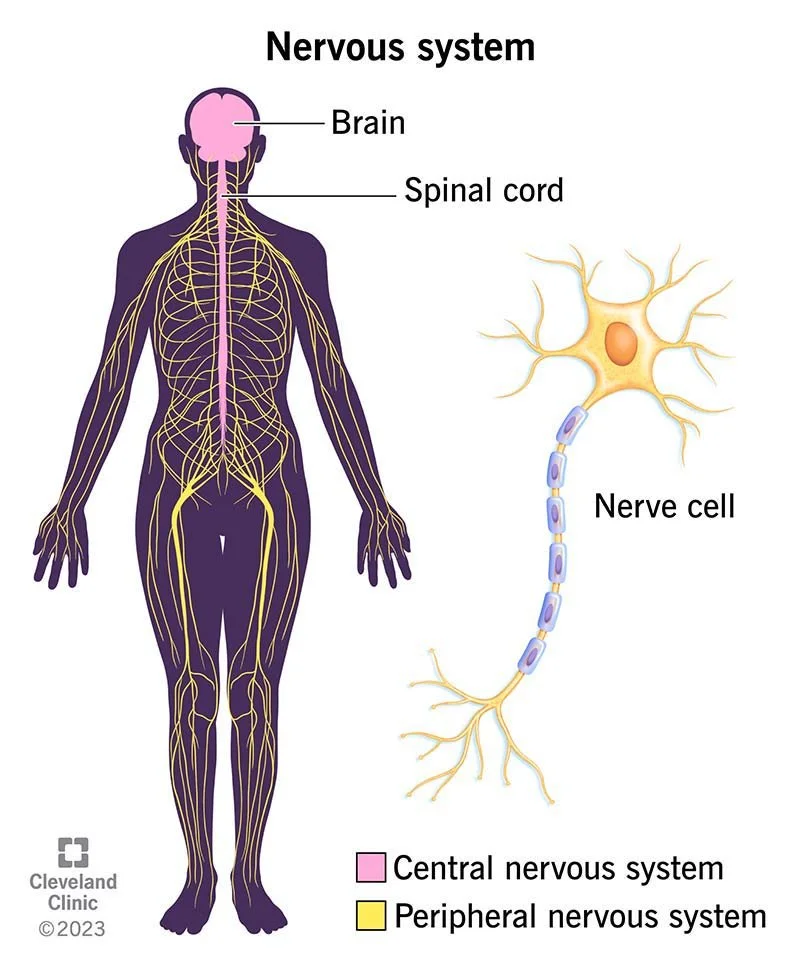
In a recent article, “The Autistic and ADHD Nervous System,” Dr. Megan Anna Nef writes about the two primary parts of our nervous system -
“First is the central nervous system (CNS), which is made up of the brain and the spinal cord. Simply, the central nervous system is responsible for receiving sensory signals, processing information, and sending motor signals to the body. This is like the control center for the nervous system. No sensation exists until the signal hits the brain.
The second is the peripheral nervous system (PNS), which comprises all nerves, neurons, and ganglia outside of the brain and spinal cord in the rest of the body. This system is responsible for sending commands from the CNS to the body via motor neurons and receiving information about the internal and external environment via sensory neurons. The PNS plays a vital role in the mind-body connection.”
Some of the key functions of the nervous system are -
Sensory Input: Collects information from inside and outside your body using sensory receptors (like your eyes, skin, and ears).
Integration: Processes this information in the brain and makes decisions about how to react.
Motor Output: Sends signals to muscles, organs, and glands to trigger actions (like moving your hand away from a hot stove).
Our body and mind are always in communication, understanding this is the beginning of tapping into practices which help us care for our nervous system, and reject this cultural ideal of pushing through which can lead to the body passing out from the sheer level of exhaustion.
Understanding Nervous System Care & How It Can Support Us on a Neurodivergent Parenting Journey
Real talk, Mamas, most of us learn to override what the body is communicating. This is not a judgement because in our world, this is survival.
We often cannot stop for the kind of nourishment our bodies are practically screaming at us to embrace.
There are endless phone calls to doctors and insurance companies to make, IEP meetings to attend where we are advocating for our kids, and all the other endless things we juggle, day after day. But after a while, this relentless pace of disability parenting starts to stack. And we need something deeper than surface-level self care; we require ongoing nervous system support which gently invites us
to listen to our bodies, not run away from them.
Maybe you’re thinking this all sounds good in theory, but how do I actually make it happen in the messiness of real life? And I totally hear you.
There are some core practices you can lean into for support - not just in the moments of overwhelm, but as a regular practices for nourishing your nervous system.
1. Root in the Breath As an Anchor: It sounds simple, just take a breath. But slowing our breathing takes us off auto pilot and signals to the parasympathetic nervous system that we are
beginning to call in calm even if we’re in the midst of chaos.
Gentle, Slower Breathing -
Place one hand on your heart space, and another on your belly
Close your eyes or lower your gaze if that feels supportive; you might also choose to keep your eyes open, too, if that feels safer.
Begin to slow your breathing, inhaling at a pace that feels good for you, hold your breath for 3 seconds, and then slowly release your exhale, letting the air flow from your mouth gently.
As you continue to breathe at a slower rhythm, draw your attention to the surface beneath you, notice any sensations that arise as you sink into the feeling of being held and supported.
Feel free to breathe at this pace for as long as you have available.
Remember, you can root in this practice of gentle slower breathing in the bathroom, carpool line, or anywhere else where you need.
2. Humming and Singing: Growing up in church, I remember the sound of older women humming softly as the choir sang. I had no idea they were soothing their nervous system; According to the Trauma Research Foundation: “Gentle sounds, such as humming, calm the vagus nerve, which connects to the larynx (voice box) (Thibodeaux) as well as the middle ear, chest, lungs, and gut.
When we hum and make other similar sounds, we calm and soothe this nerve. This action “creates a positive state of relaxation and social engagement” and “has a calming, soothing effect, and promotes rest and restitution” (Rosenberg 34). Both humming and signing stimulate the vagus nerve which is “the longest cranial nerve in the body. It forms a crucial bidirectional communication pathway, connecting your brain, heart, lungs, and gut.”
Try it now:
Place one hand (or both) on your heart space
Close your eyes, lower your gaze or keep them open (whatever feels most supportive)
Now begin to hum making the mmmmmm sound (like you would if you were enjoying a delicious meal)
Notice the vibrations in your heart space and throughout the body.
You can also try to make this again by placing both hands on your cheeks, and making the mmmmm sound. Notice the vibration moving through your hands and cheeks, let it soothe you as you continue to breathe within your own rhythm.
3. Rock and Self Soothe with Gentle Touch:
Did you know something as simple as rocking back and forth, or side to side as you slow your breathing helps soothe your nervous system? Rhythmic motion activates the parasympathetic nervous system, which reduces stress hormones like cortisol, slows heart rate, and deepens breathing.
Studies show this gentle movement can lower blood pressure & ease tension, creating a state of physical relaxation. Movement engages the vestibular system, the sensory network in your inner ear responsible for balance and orientation. This soothes hyperactivity in the brain, stabilizes emotional states and reduces mental agitation, making it particularly effective for managing stress or sensory overload, according to Donovan Sound Health.
Check out this practice of rocking and self soothing through gentle touch I shared a few months ago on Instagram, and drop into calm:
4. Brainstem Calming (with warmth & gentle touch):
Rub your palms together until they feel warm.
Gently press them against your forehead, and connect with the sensation of warmth on your skin. Breathe in and out slowly.
You can also gently press against your cheeks, and again, connect with the sensation along your skin. Breathe in and out slowly.
Do this as long as you needed to ground yourself.
This practice helps soothe your vagus nerve which activates the parasympathetic nervous system and pulls you out of fight or flight mode.
5.Belly Breathing: Belly breathing helps you “focus on expanding your abdomen as you inhale, rather than just your chest. This technique utilizes the diaphragm, a muscle below the lungs, to draw air into the lungs, resulting in deeper, slower breaths,” according to Good RX.
Breathing in this way comes naturally to us as babies. As we grow older, and the stresses of life begin to stack, we sink into autopilot, and before long, we’re in a rhythm of chest breathing which often looks like shallow and rapid breaths which can exacerbate stress and overwhelm, instead of calling us into calm.
There are many nights where my nervous system is charged from the hyper vigilance of high support needs disability parenting. The body remembers; we must give it a pathway to ease.
This practice is supportive for settling into rest, or soothing nerves in the midst of stress and tension. And we could all use that support right?
Soooo…how do you start Belly Breathing?
Choose a quiet space - this could be your car, the bathroom, etc. Anywhere you will have peace for a few moments.
You can either lay down (my personal favorite as it feels most relaxing) or sit upright, feet firmly on the floor or ground (if you are outside)
Place one hand on your heart space and the other hand on your stomach.
Close your eyes or lower your gaze.
Breathe in slowly & deeply through your nose, feeling your belly rise on your inhale.
Exhale slowly & deeply through your mouth, feeling your belly drop as you exhale.
Repeat these steps as often as you like to call in calm.
